When product marking has to stay readable
Product identification is the practical side of engraving. It covers names, batch numbers, model codes, serials, logos, asset tags, warnings and ownership details that must remain legible after regular handling. For businesses in Pretoria East, Centurion, Midrand and Johannesburg, it is often the difference between a neat, traceable product and a confusing pile of similar items on a shelf or workbench.
Laser engraving suits product marking where labels can peel off, fade in sunlight or get damaged by moisture and cleaning chemicals. On wood it gives a dark, permanent mark with a natural finish. On acrylic it can create clean frosted or etched areas for clear naming plates. On glass it gives a fine permanent mark for awards, bottles and display items. On leather it works well for straps, wallets and soft goods. On coated or bare metal it can be used for serial numbers, asset tags and technical details that must stay in place for years.
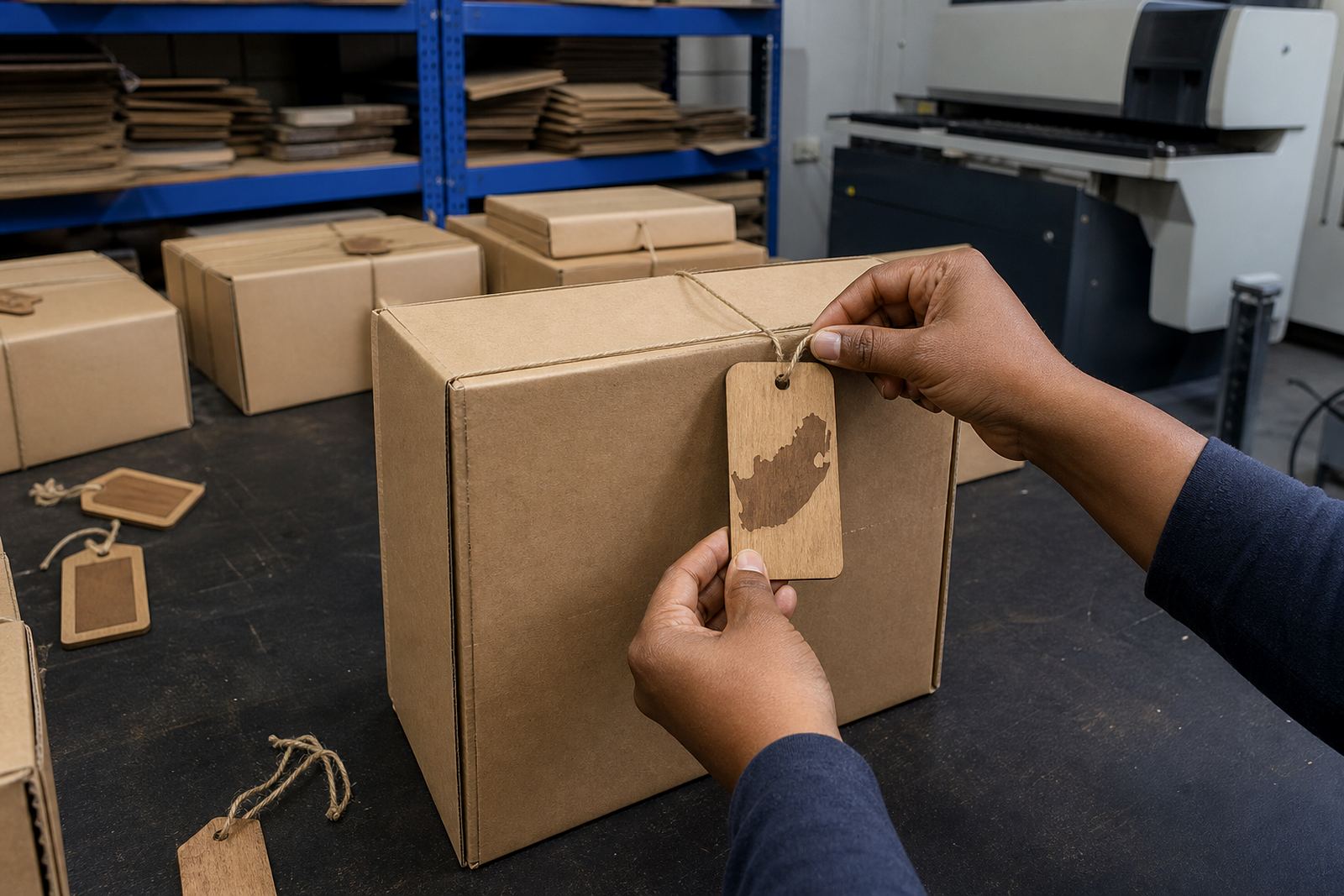
For local businesses, especially where stock moves between branches or sites, clear identification also supports receiving, dispatch and record keeping. It helps with warranty control, internal asset registers and ownership records on items that are loaned out, used on site or sent by courier to Durban and other parts of South Africa.
Typical items that suit engraving well
Not every product needs the same marking method. Some items only need a small code in a hidden corner, while others need a full face label that can be read quickly. At our Pretoria East base, we help clients plan what should be marked, where it should sit and how bold it needs to be for day to day use. That planning saves time later and avoids artwork that is too small or too crowded.
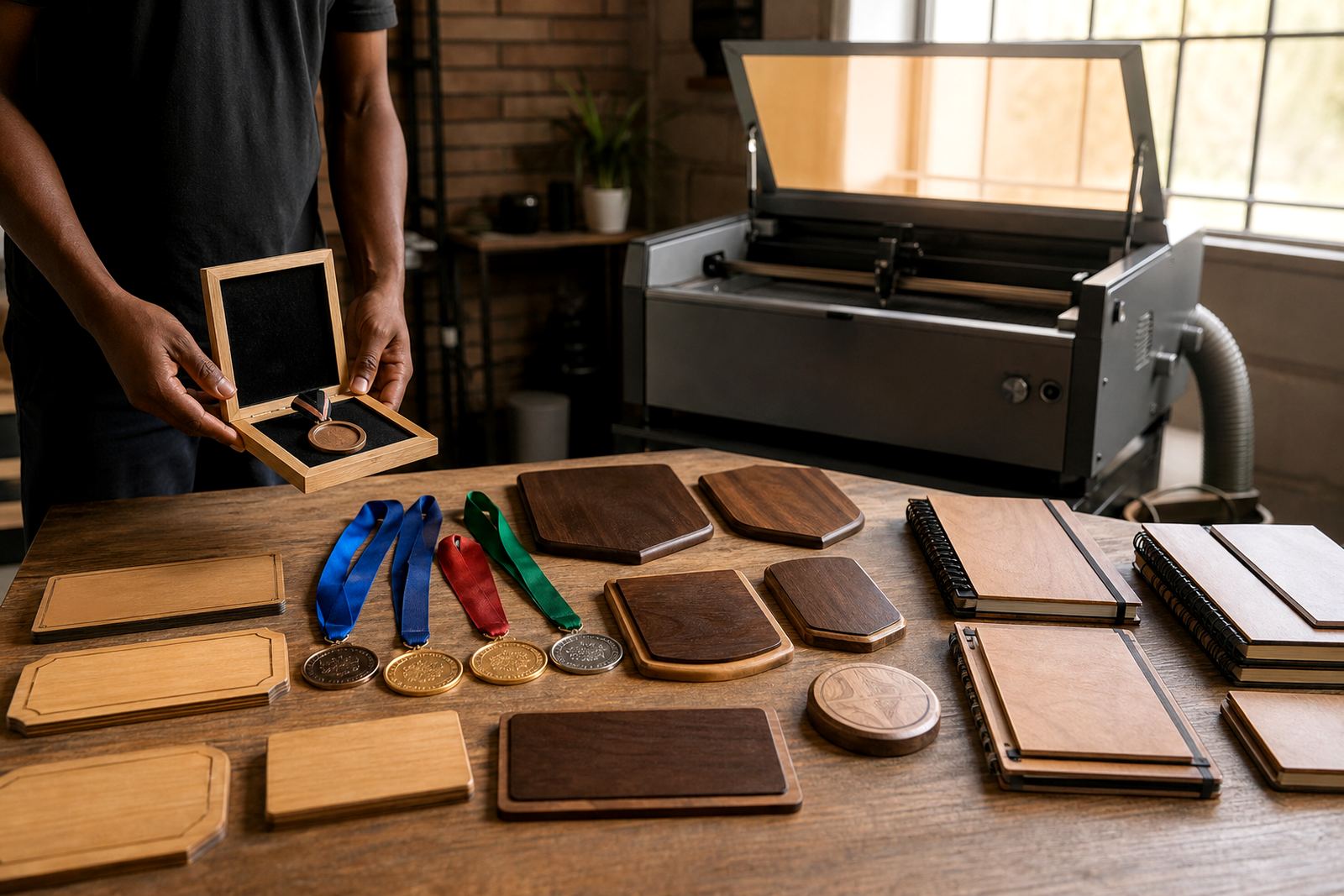
Common product identification jobs include retail stock, promotional items, tools, giftware, event packs and office assets. For example, a wooden box may need a name on the lid and a code underneath, while a metal component may need a serial number that stays clear after handling. Acrylic plaques can carry product names or room identifiers. Leather items need careful layout so the mark stays neat without flattening the material too much.
- Asset tags for offices, schools and clinics
- Serial numbers and batch codes on parts or housings
- Ownership details for tools, cases and personal items
- Product names on gift sets and retail packaging
- Logo and model marking for display pieces and samples
Planning the layout before anything is marked
Good product marking starts with layout planning. The size of the item, the available engraving area and the final reading distance all matter. A code that is easy to read at arm's length may be too large for a small tag, while a tiny serial number can disappear once the surface has texture or grain. We usually help clients decide on font choice, line thickness, spacing and the best position for the mark before production begins.
If the product is curved or uneven, that also changes the plan. A flat acrylic plate can take a neat centred layout, while a rounded bottle cap or leather strap may need a shorter line and less detail. For wood, grain direction can affect contrast. For metal, the finish will influence how deep or light the engraving appears. That is why material guidance and proof approval matter, especially where the same mark must be repeated across a batch.
- Keep text short where possible, especially on small items
- Allow for clear margins so the mark does not sit too close to an edge
- Choose a font that remains readable after handling and cleaning
- Use consistent codes across batches to avoid reorder errors
- Check whether the item will be filled, coated or assembled after marking
Common mistakes that cause costly rework
The most common mistake is trying to fit too much information into a small space. If the layout is crowded, the engraving may look fine on screen but become difficult to read on the finished item. Another issue is sending artwork that has low quality logos, damaged text or the wrong dimensions. In those cases, logo redraw or file conversion may be needed before the engraving can go ahead.
We also see problems where the client has not confirmed the exact product size. A few millimetres can matter on tags, plaques and small parts. If the mark sits too close to a screw hole, edge or hinge, the item can look unbalanced or the engraving may interfere with use. For batch personalisation, another risk is inconsistent spelling or changing details from one file to the next, which can lead to mismatched stock. A quick proof check avoids most of this.
Coastal humidity can affect how some materials are stored before marking and packaging, especially when items are being couriered from Gauteng to Durban. If material arrives damp, dusty or with protective film left on too long, the final result may vary. Proper packaging prep and clear handling instructions help keep the finish consistent.
Budget ranges and what changes the cost
Budget depends on material, size, quantity and the amount of setup work needed. A simple one-off name or code on a small item costs less to prepare than a batch of mixed products with different layouts. Artwork Setup, Layout Planning, Font Selection and File Conversion can also affect the total if the supplied file is not ready for production.
Clients in Pretoria, Centurion, Midrand and Johannesburg often ask for a practical range before they commit. As a guide, the final figure is usually influenced by the number of items, whether each item is identical, how much detail is required, and whether mounting or packaging prep is needed. Reorder Matching can lower setup time on repeat work when the same specification is used again. Courier delivery across South Africa is also taken into account for out of town orders.
- Single item work usually has a higher setup cost per piece
- Batch personalisation is more efficient when the same layout repeats
- Complex artwork, logo redraw and proof changes add prep time
- Special handling for fragile glass or coated metal can affect pricing
- Packaging and dispatch requirements matter for mixed or fragile orders
How LightBurn Engraving handles repeat orders
LightBurn Engraving works from Wapadrand in Pretoria East, with Thabo Abrahams as Managing Director and a team that includes operations, laser production, client services, artwork and dispatch support. That structure helps when product marking needs to be consistent over time, especially for businesses that reorder the same assets, labels or ownership details.
For repeat jobs, we keep the approved layout details on record so the next run matches the previous one as closely as possible. This matters for stock systems, signage sets and numbered products where even a small change in spacing or font can cause confusion. We also assist with mounting options where the engraved item needs to be fitted, displayed or packed for dispatch.
Clients reach us through the enquiry form on our contact page, and we work with orders in Pretoria East, Pretoria, Centurion, Midrand, Johannesburg, Durban and across South Africa. Whether the marking is for one special item or a larger batch of product identification, the aim is the same: clear information that stays readable and suits the material it is engraved on.