What the Kempton Park brief called for
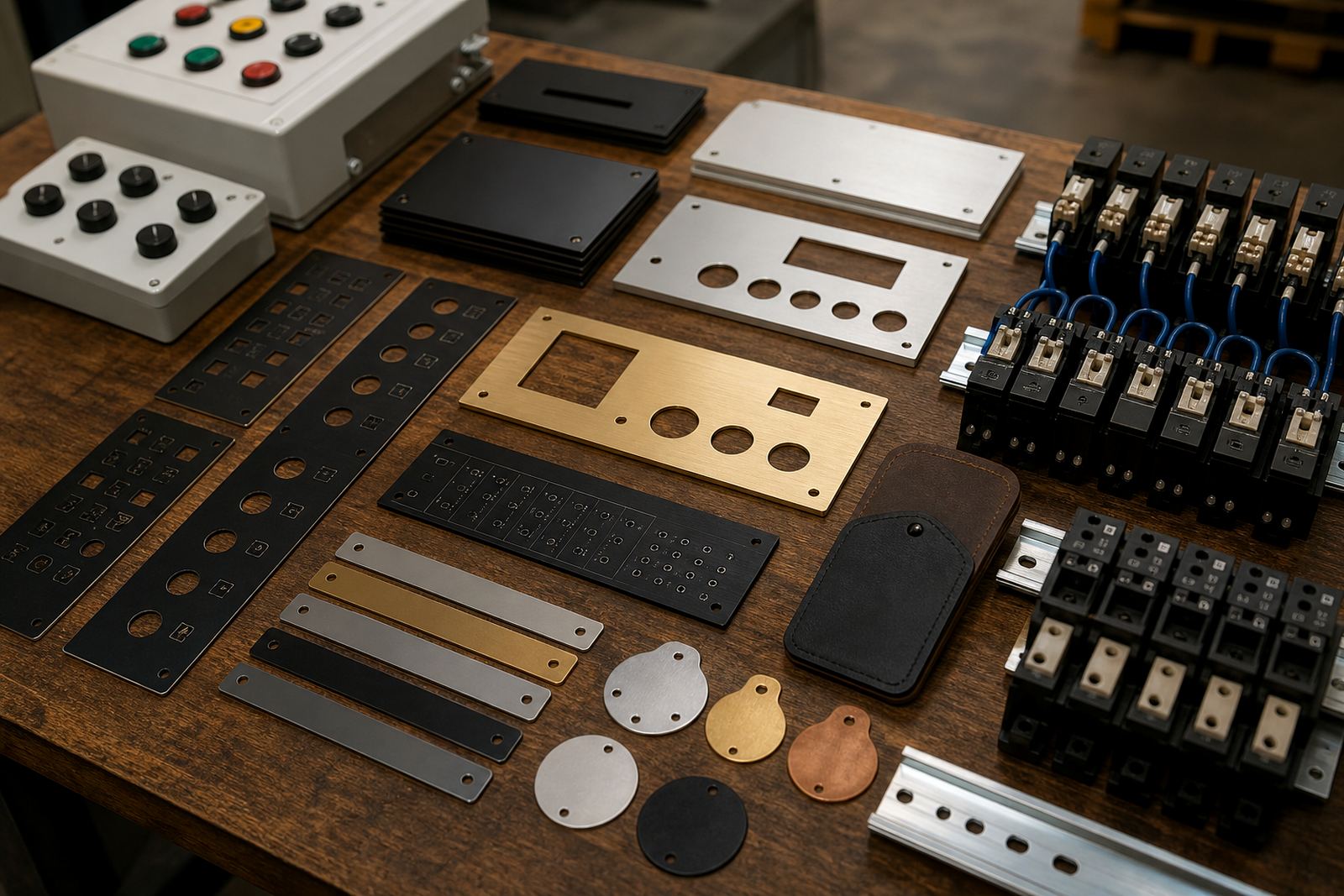
The job came from a facilities team in Kempton Park that needed new labels for a control area where several switches, isolators and indicators had to be marked clearly. The existing labels had faded and some of the text was too small, so the team wanted engraved faceplates that could stand up to daily handling and regular cleaning.
Because the panels were being used on site, the client needed markings that were easy to read at a glance and consistent across every unit. The wording had to match the existing circuit schedule, with no room for guesswork when a technician was working under pressure.
- Client type: industrial maintenance team
- Town: Kempton Park, Gauteng
- Work type: engraved faceplates and switch identifiers
- Main need: fast reading and long term clarity
Materials and engraving choices we made
For this project we recommended engraved plates with high contrast lettering so the markings would stay legible even in low light. Where panels see dust, vibration or repeated wiping, engraved text is a better choice than surface print because the information is cut into the material, not sitting on top of it.
We also advised on size planning and font selection, making sure the wording stayed readable from normal working distance. Small labels can look tidy on a drawing but still be hard to use in practice, so the spacing and line breaks had to be set carefully. On some of the tighter faceplates, we adjusted the layout to avoid crowding and kept the text sharp and even.
- Material guidance for indoor industrial use
- Font selection for quick legibility
- Size planning around limited faceplate space
- Layout planning to keep each label consistent
How the panels were prepared and engraved
The artwork came in as a mixture of old schedules and handwritten notes, so we first handled file conversion and logo redraw where needed, then cleaned up the wording for the final set. Once the text was confirmed, each faceplate was set up for engraving with the correct switch names, reference marks and mounting positions.
Our laser production process allowed us to keep the line work clean and repeatable across the whole batch. For panel work, the key is not only the engraving itself but the handling around it. We checked alignment, spacing and finish before moving the pieces on for packaging prep. That way the client received parts ready for installation rather than items that still needed sorting on site.
- Artwork setup and file conversion
- Logo redraw where older files were unclear
- Batch personalisation for multiple faceplates
- Packaging prep for site delivery
Constraints on a working site
The biggest constraint was keeping the labels practical for a real control environment. The faceplates had to remain clear under normal wear, and the marking had to make sense to the people using the panels every day. There was also the usual problem of keeping a consistent layout when different switch names vary in length.
That means the job has to be organised carefully, with correct proof approval before production and no unnecessary back and forth. The client wanted a clean result, not a fussy process.
- Readability in low light
- Consistency across different faceplate sizes
- Durability for daily handling
- Proof approval before final engraving
Timeline from artwork check to delivery
The project ran over two weeks from the first enquiry to dispatch. In the first week we sorted the label list, confirmed the wording and adjusted the layout so every switch identifier matched the control schedule. During the second week we completed engraving, checked the finish, and prepared the order for courier delivery.
Because the client needed reliable turnaround and no confusion on the shop floor, we kept the process tight and practical. Once the final proof was approved, the batch was completed in order and packed to reduce handling marks in transit. Courier delivery then went out from Wapadrand to Kempton Park without delay.
Result on the control panels
The finished faceplates gave the team a neat, uniform set of identifiers that were easy to read and easy to fit. The engraved lettering gave a sharper appearance than the worn labels they had before, and the panel area looked more organised once the labels were installed. That matters on site because clear marking cuts down on hesitation when a technician is tracing a circuit or isolating equipment.
The client also had the benefit of a repeatable set-up for future work. If more panels are added later, we can match the layout and wording so the new pieces sit alongside the existing ones without looking out of place. That is usually what a good marking job should do: make the equipment easier to use, not more complicated.
- Clear switch identifiers for day to day use
- Matching labels across the full panel set
- Cleaner appearance after installation
- Easy to repeat for future additions
What we would repeat on the next panel job
For a similar job, we would again start with a careful label audit and a proper proof stage before engraving anything. That saves time later and helps avoid errors on circuit names or mounting positions. We would also keep the layout simple, using a font and spacing that stays readable even when the panel is installed in a tight corner.
For industrial labels, the best result comes from getting the basics right: accurate wording, consistent alignment, and a finish that suits the environment. Whether the panels are for Pretoria East, Johannesburg, Centurion or anywhere else in Gauteng, the process stays the same. Clear brief, careful setup, clean engraving, then secure delivery.
- Start with a full label list
- Approve the proof before production
- Match the marking style to the site conditions
- Use courier delivery for multi-site projects
Job details
| Project | Kempton Park Panels |
|---|---|
| Client type | Industrial maintenance team |
| Location | Kempton Park, Gauteng |
| Work supplied | Engraved faceplates and clear switch identifiers |
| Timeline | 2 weeks |
| Delivery | Courier delivery across South Africa from Pretoria East |